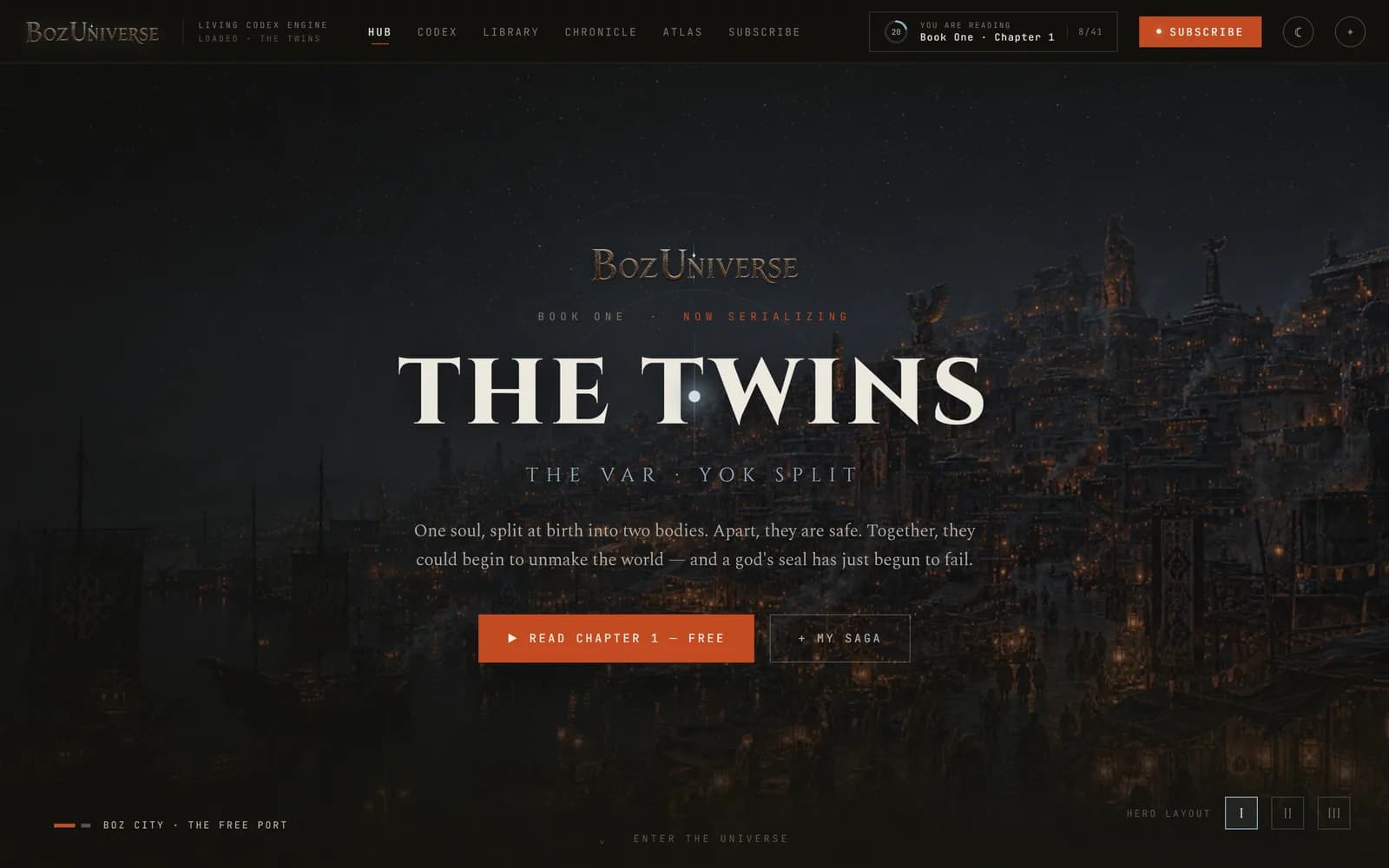
At a glance
- What it is. A prototype for an interactive fantasy serial, six connected surfaces on one system.
- The idea. Reading progress is product state. You only ever see the lore you have earned, so the world can be deep without spoiling itself.
- Behind it. 78 source documents and about 30,000 words of structured worldbuilding: cosmology, pantheon, dynasties, characters, story, events, worlds, places, culture, items.
- What it is not. There is no backend, no account, and the subscribe flow is a concept. Nothing here is production.
- Why it is in this portfolio. It is the only project of mine that invents a product model rather than executing a known one.
The problem
A large fictional world punishes the reader twice.
Read it without a reference and half the names mean nothing. Open the reference and it tells you how the story ends. Every wiki for every serial has this shape: a complete, spoiler-dense encyclopedia, written for people who have already finished, sitting next to a story written for people who have not.
The reader is asked to choose between confusion and spoilers, and both choices make the world feel like homework.
The idea
Knowledge should be state the product holds.
If the system knows where a reader is, it can answer exactly the question in front of them and refuse the ones they have not reached. The encyclopedia stops being a hazard and becomes part of the reading. And withholding turns into a mechanic rather than an omission, because a sealed entry tells you something is coming.
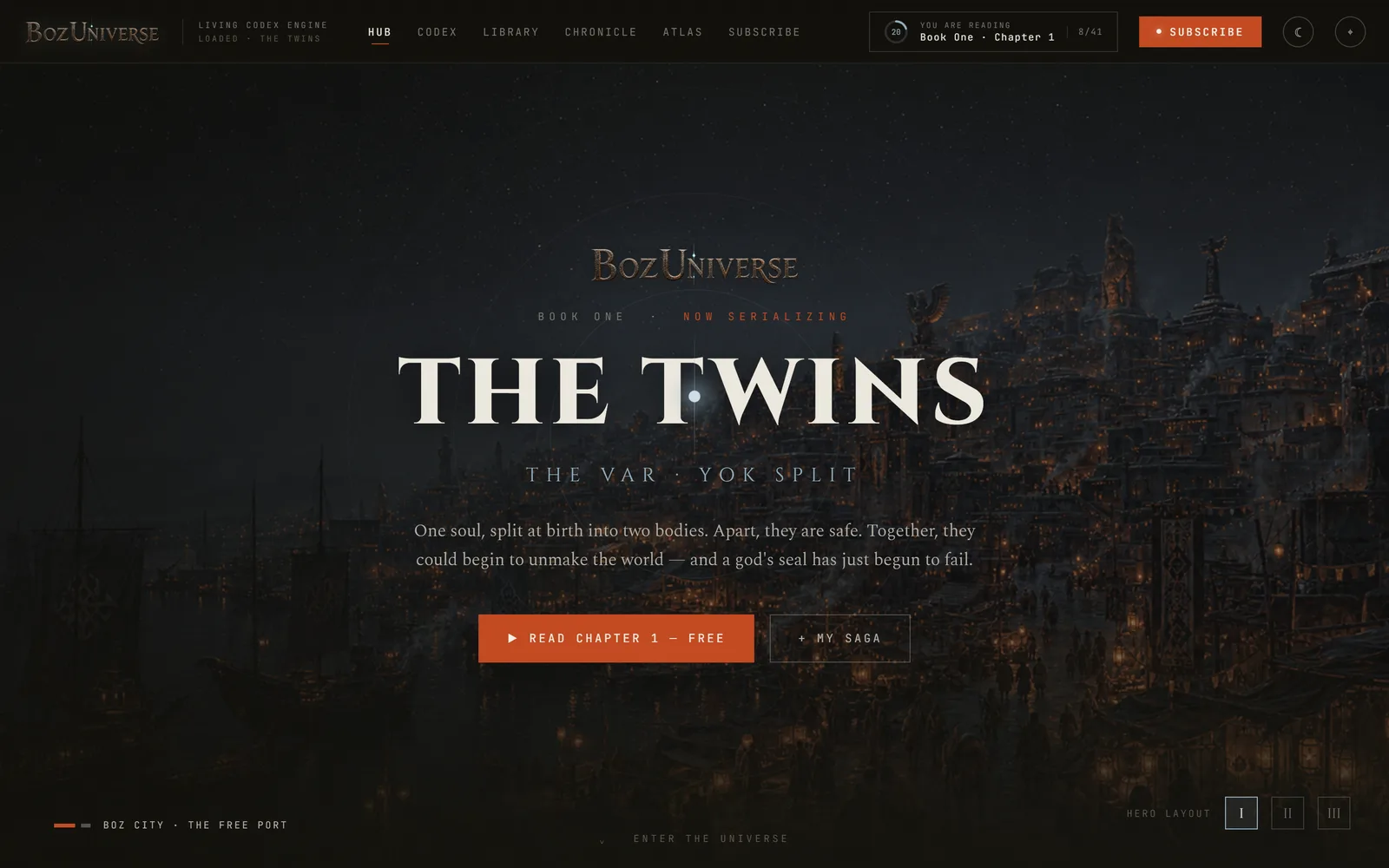 The hub. One premise, one free chapter, and a persistent bar showing the reader where they are in the book.
The system
Everything in the world is an entity with a reveal condition, not a page.
Characters carry a model rather than a biography: Want, Wound, Contradiction, Stakes. That is a dramatic structure, and holding every character to it is what stops a cast of twelve from turning into twelve descriptions. Places, events, concepts and chapters are entities too, and they all reference each other.
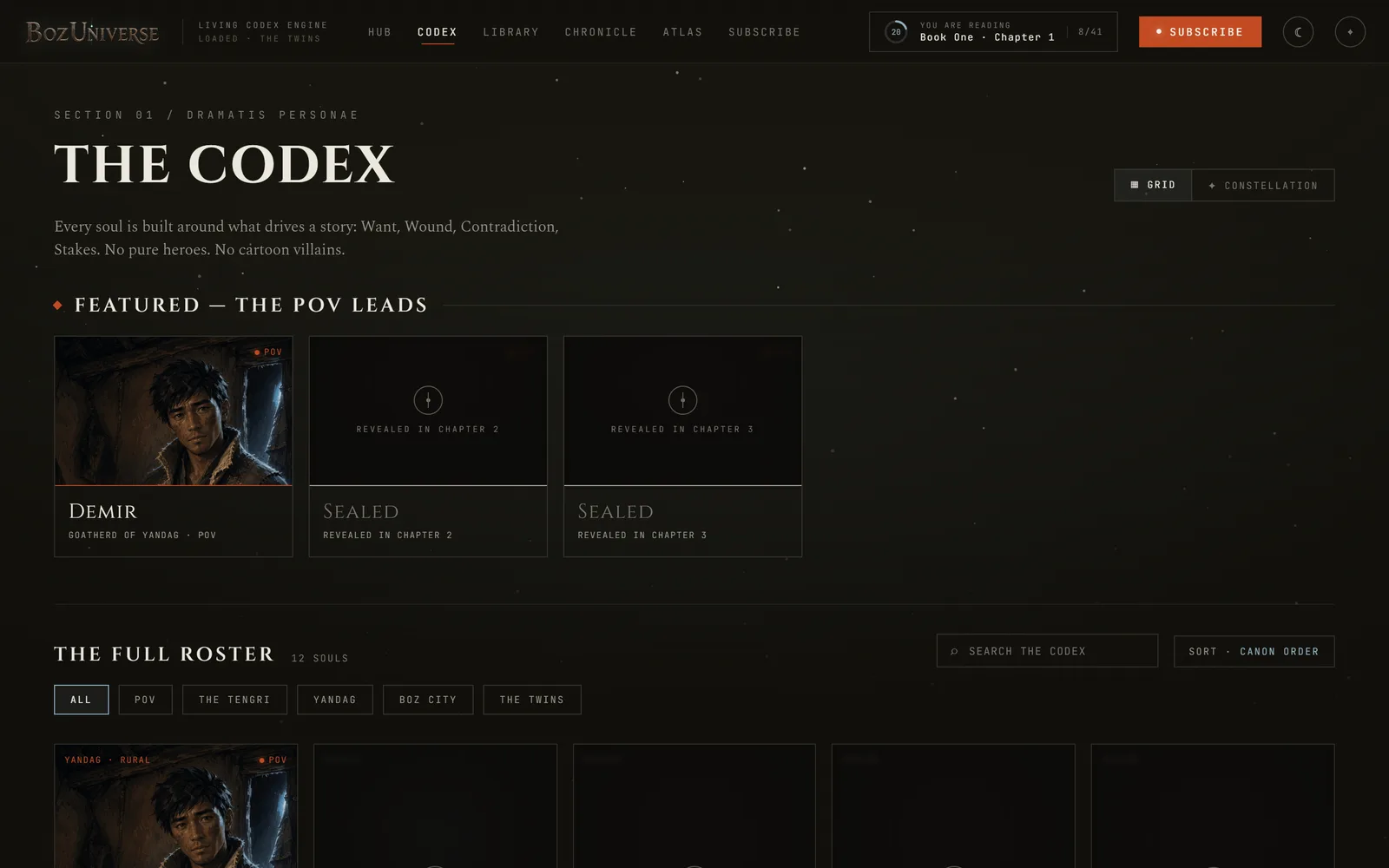 The Codex at chapter one. Demir is visible; the other point-of-view leads are sealed, and the seal names the chapter that opens it rather than hiding that they exist.
The reveal condition is the only rule the whole product needs. The Codex reads it to decide who is a card and who is a seal. The reader reads it to decide which terms are live. The Chronicle and the Atlas read it to decide how much history and geography exists yet.
The look
A world this old needs a surface that does not look invented last week.
Cinzel carries the display type and Spectral the reading, which is the pairing the whole thing rests on: one is carved, the other is meant to be read for an hour without noticing it. Ember and sky sit against an ink scale as the only two accents, so a sealed entry and an open one are told apart by temperature rather than by an icon. The starfield and the corner brackets are the two motifs that repeat, and they are what make a codex entry and a chapter page feel like the same object.
The system is here, running: open the design system →. Eighteen cards, each rendered from the same tokens the prototype uses rather than captured as a screenshot, with the reader platform at full size as the last one.
The Figma half
The code came first, so the Figma library was built to mirror it rather than the other way round.
Every colour, space, radius and duration is a variable named for the CSS custom property it stands for, with dark and light as modes of the same collection. The components carry the states the product actually turns on, revealed and sealed, live and locked, as variants rather than as notes in a margin.
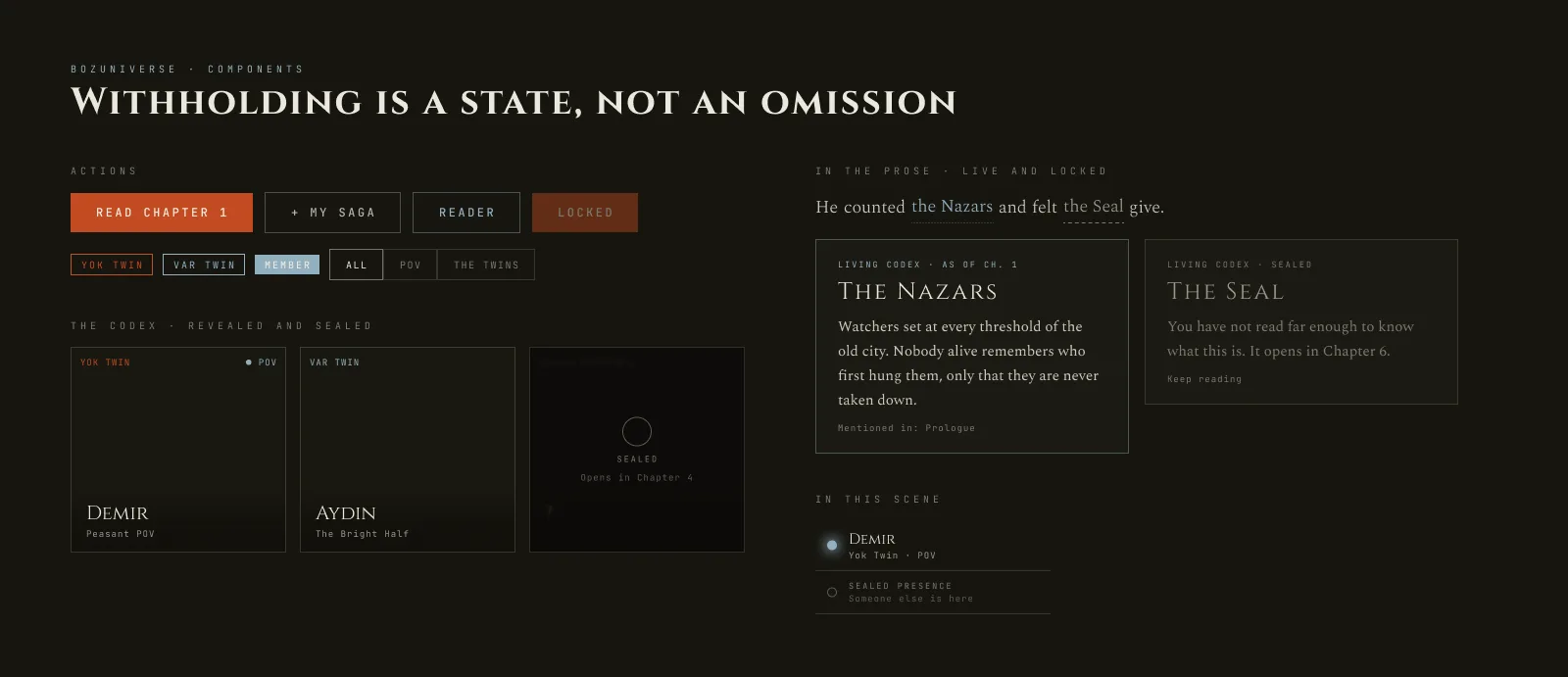 The components, composed from instances. The sealed card, the locked term and the locked panel are the same components as their open versions, one variant apart.
Building it was also an audit. Mirroring the tokens one by one surfaced five places where the code had drifted from its own system: a card background typed in by hand, a footer gradient that was simply black, transitions off the duration scale, a prototype running on a private copy of the palette, and controls that were never buttons. Light theme was where it showed. Flipping the mode on the reader in Figma made the hardcoded black visible at once, and in the prototype the same drift had left cream text on a cream page. All five are fixed in the code now, and the light reader below is the same frame as the dark one with only the variable mode changed.
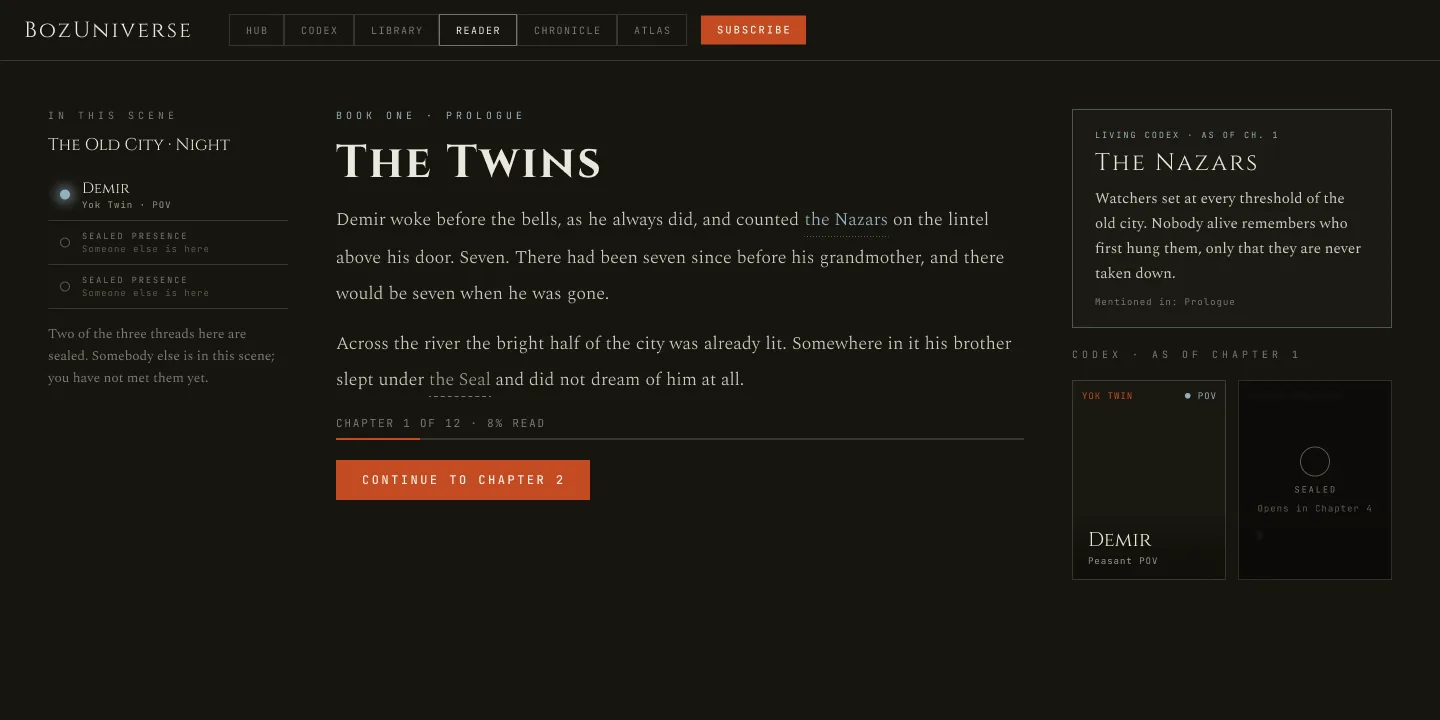 The reader in Figma, dark.
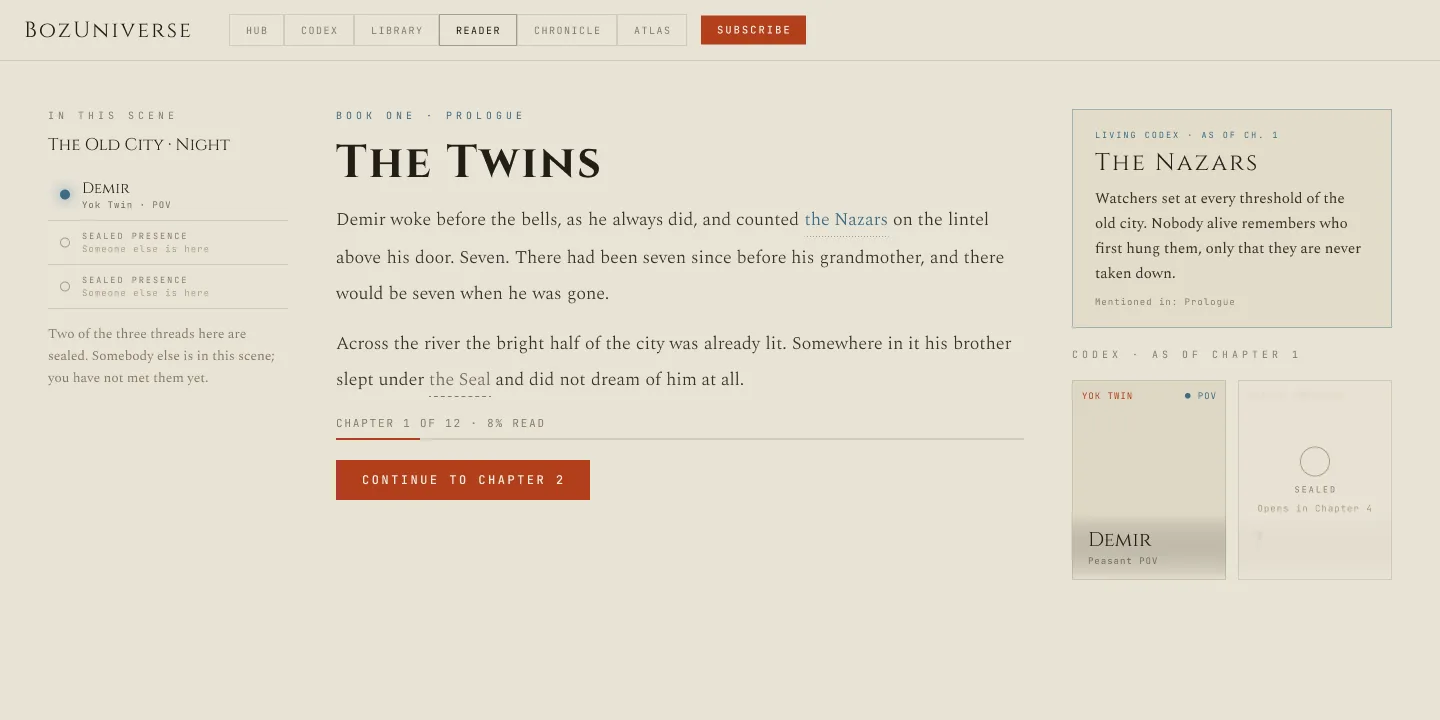 The same frame, light. Nothing was redrawn; the mode changed.
The file is open to look through: open it in Figma →
The reading surface
This is where the argument either works or does not.
The prose carries underlined terms. Opening one brings up what that thing is at this point in the story, and nothing beyond it. The left rail names where the scene is and who is in it, and the characters you have not met yet are present as sealed rows rather than absent, so the page tells you the truth about its own shape.
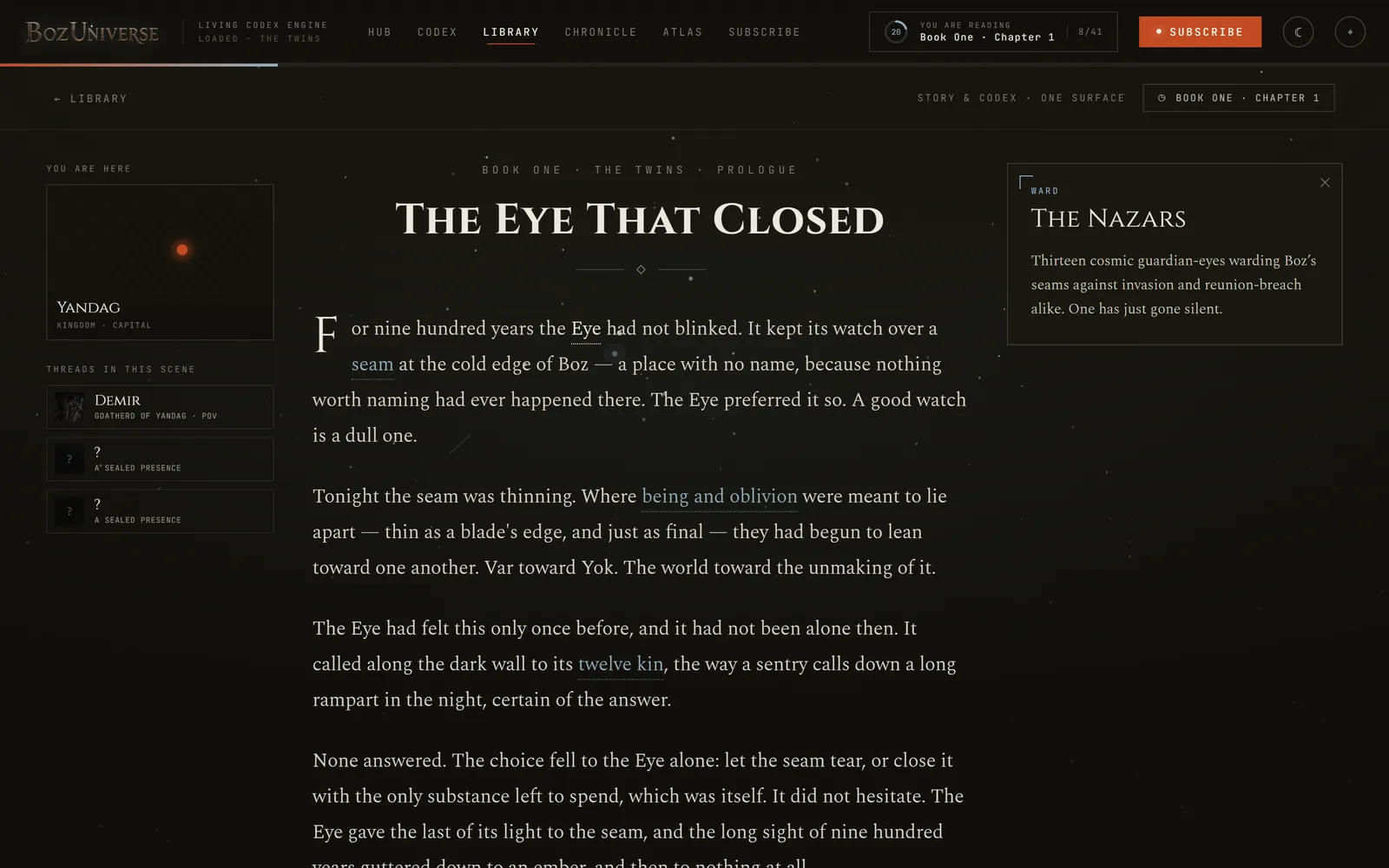 The whole idea in one screen. The term opens to what it means now. Two of the three threads in the scene are sealed presences, which is a spoiler-free way of saying somebody else is here.
The other two surfaces
The Chronicle is history as cause and effect rather than a list of dates. Events are the dots and the stories draw the lines between them, so the timeline is something to reason about instead of memorize.
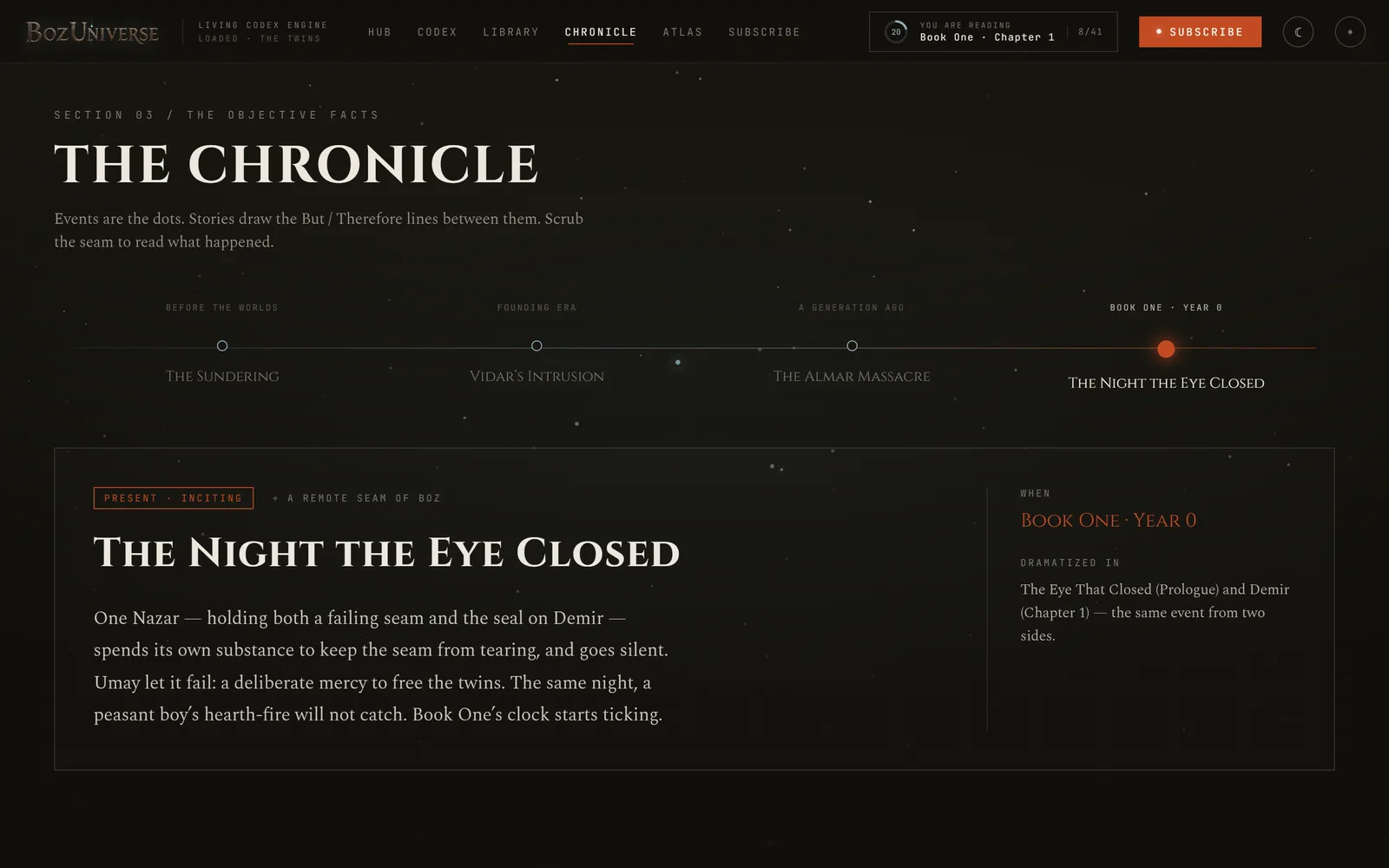 The Chronicle. Each event states what it set in motion, and the clock of Book One starts at the last one.
The Atlas puts the same progression on geography. Places you have read about are discovered; the rest are shapes on a map, which gives exploration a reason to continue.
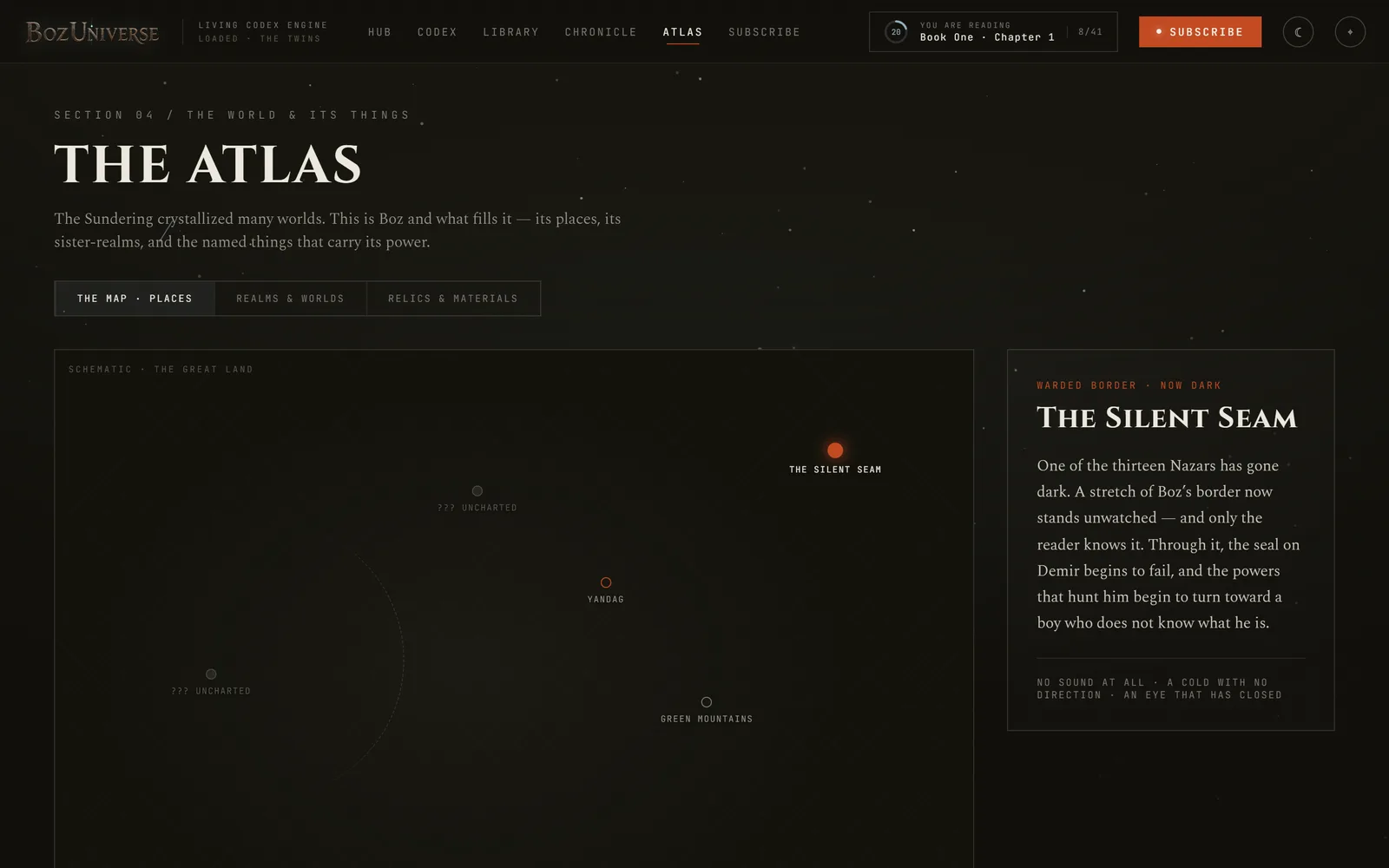 The Atlas. Discovery is earned the same way the Codex is, so the map fills in as the book does.
The product model
A free first chapter, a serial release, and a subscription for the rest. The unlocks do double duty: they are the spoiler mechanic and they are the reason to keep a subscription, which is a rare case of a monetization model and an experience goal pointing the same way.
That is the concept. It is not implemented. The subscribe flow in the prototype is a facade over no backend, there are no accounts, and progress is not persisted anywhere real.
What this is, honestly
A prototype that argues for a product, not a product.
It demonstrates the model end to end: the content structure, the six surfaces, the progression, and enough real writing behind it that the system is exercised rather than mocked. What it does not demonstrate is production engineering, and it would be dishonest to put it beside the live things in this studio and let the difference go unmentioned.
It carried debt, and some of it is paid. Every control used to be a clickable div, unreachable by keyboard or screen reader; they are real buttons now, the dialogs trap and return focus, the sealed stars in the constellation are named without spoiling who they are, and the whole thing honours reduced motion. What is left: the lore panel does not present properly at tablet widths, at phone width the theme toggle is crushed and the chapter list overflows, and the faintest light-theme tokens sit near 2:1 against the page. Those are exactly the things I gate other people's work on, and naming them is cheaper than pretending a prototype is further along than it is.
Why it is here
Everything else in this portfolio is execution against a known problem. A design system for a team that needs one. A conformance engine for a gap in tooling. A marketplace for an information asymmetry that already existed.
This one started from nothing anybody asked for, and the work was deciding what the product should be at all: what the entities are, what the mechanic is, what the reader earns and when. That is a different muscle, and it is the one that is hardest to show.
Open the prototype → · Open the design system → · Open it in Figma →